
Growing your speech therapy clinic’s client base is all about visibility, and with most people turning to the internet for healthcare solutions, a robust online advertising strategy is crucial. By leveraging Google Ads, you can display targeted ads to users actively searching for speech therapy services, ensuring that your clinic appears right when they need it most.
Whether you’re new to digital marketing or looking to refine your existing efforts, getting to grips with Google Ads can transform your business. Tailoring your message to resonate with your audience, selecting the right keywords, and setting a sensible budget are just the starting points to drive high-quality traffic to your clinic’s website and, ultimately, through your doors.
If you need help with setting up and managing Google Ads for your speech therapy clinic, book an appointment here to see how we can help you achieve your goals.
Why Use Google Ads for Your Speech Therapy Clinic?
One major advantage of Google Ads is its ability to reach potential clients at the moment they’re searching for speech therapy services. Clinics can showcase their services using targeted keywords that align with clients’ search inquiries.
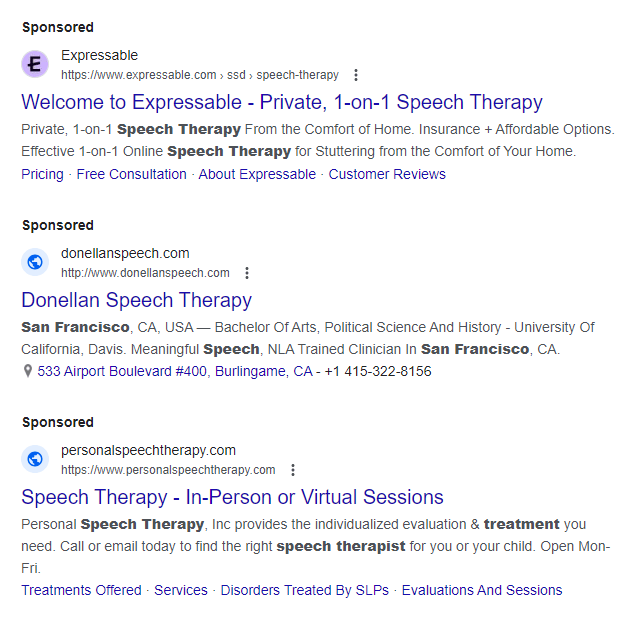
Furthermore, Google Ads operates on a pay-per-click (PPC) model, which means clinics only pay when a user clicks on their advertisement. This can lead to cost efficiency as the clinic’s budget goes directly towards engaging interested parties.
The beauty of Google Ads lies in its flexibility and measurability. You can fine-tune your campaigns to target specific demographics, locations, and even times of day, optimizing your ad spend to reach those most likely to need your services. Coupled with insightful analytics, Google Ads provides you with real-time feedback on the performance of your advertisements, allowing for swift adjustments to maximize effectiveness and ROI.
Setting Up Your Google Ads Account
Before you dive in, you’ll need to select the right campaign type, identify your keywords, write engaging ad copy, and set up conversion tracking for your speech therapy clinic.
Selecting the Right Campaign Type
Your first step in Google Ads is choosing a campaign type that aligns with your clinic’s goals.
Search campaigns are ideal for when you want to be seen by users actively looking for speech therapy services. Display campaigns are used for broader visibility to raise awareness. Video campaigns can be effective to engage an audience through compelling narratives or testimonials about your clinic. Performance Max is one of the newest campaign types that combines all of Google’s channels like Search, YouTube, Display, Discover, Gmail, and Maps for maximum exposure.
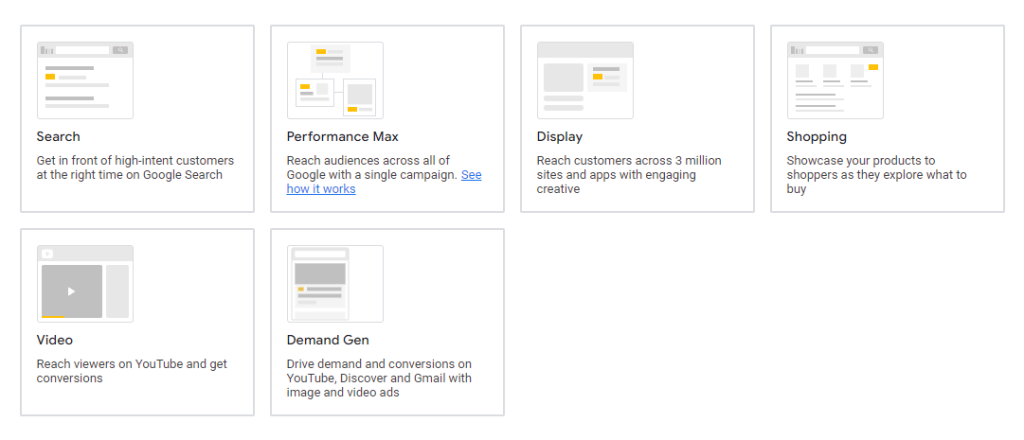
In managing speech therapy accounts, I’ve found that sticking to Search and Performance Max campaigns hits the sweet spot for getting high-quality leads.
Keyword Research and Selection
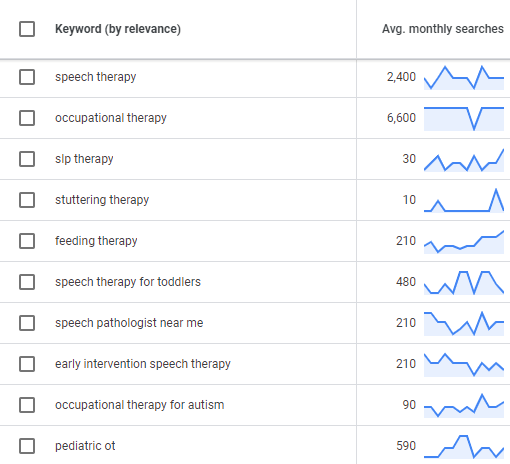
Next, it’s time to find the keywords that your potential clients are searching for. Use tools like Google Keyword Planner to discover relevant search terms.
- Start with broad terms like speech therapy, speech pathologist, or location-based terms like speech therapy in [Your City].
- Also, consider long-tail keywords, which are longer and more specific phrases that may be less competitive and more cost-effective, like stuttering therapy or early intervention speech therapy.
- If you’re offering other services, such as occupational or feeding therapy, make sure to include them as well, but dedicate a separate campaign for each service.
Crafting Your Ad Copy
An effective ad connects with your audience and compels them to click through to your website.
- Highlight what makes your clinic special, like your success rate, unique therapy methods, or a free consultation offer.
- Use a clear call-to-action (CTA), such as Book a free consultation today or Learn more about our services.
Setting up Conversion Tracking
Next, you’ll need to set up conversion tracking to measure the success of your Google Ads campaigns. This lets you see how many clicks on your ads are turning into actual clients.
This can be a tricky process as it involves some specialized knowledge.
Some of the conversions you want to track for your speech therapy clinic are things like:
- Phone calls
- Form submissions
- Online bookings
Conversion tracking informs Google’s algorithm about the most effective search terms, ads, locations, demographics, and other segments. This allows the algorithm to fine-tune campaigns and beef up lead generation. Additionally, it offers valuable insights for us as managers, which we can leverage to refine our strategies. By analyzing this feedback, we can enhance ad copy, fine-tune bids, and make precise adjustments to targeting options, among other tweaks.
Setting up these elements correctly will lay the foundation for a successful Google Ads campaign for your speech therapy clinic.
Designing Landing Pages That Convert
A successful landing page is your digital storefront, enticing visitors to take the plunge from interested to clients. It’s the make-or-break moment for capturing leads.
Key elements of a landing page are:
- Headline and Subheadline: Your headline should be attention-grabbing and inform visitors what you offer immediately. The subheadline complements the headline, giving a bit more detail.
- Clear, Concise Copy: Use short paragraphs and bullet points to explain the benefits of your speech therapy services. Specify the problems you solve and how you make your clients’ lives better.
- Visuals: Include relevant images or short videos that convey the positive outcomes of your therapy sessions. Avoid stock photos if possible and use your own original imagery.
- Call-to-Action (CTA) Button: Your CTA button, saying “Book Your Appointment” or “Get a Free Consultation,” should be big, bold, and placed above the fold.
- Testimonials/Reviews: Display a few testimonials from past clients to build trust and credibility.
- Contact Information: Make it easy to find your phone number and address, so potential clients know how to reach you.
Optimizing and Managing Your Campaign
After setting up your Google Ads for your speech therapy clinic, you’ll need to continuously optimize and adjust the campaigns to get the most out of your investment. You’ll need to relocate your budget so it’s maximizing ROI, consistently test what resonates with your audience, and adjust your strategies based on performance data.
Budgeting and Bidding Strategies
Setting your budget and choosing the right bidding strategy are foundational to your campaign’s success. A low budget of only a few hundred dollars a month will not allow the campaigns to get enough data and optimize the performance. I suggest a budget of at least $1000 a month for starters. This budget should be able to feed Google with enough performance data for the account to start performing better in a month or two.
When it comes to bidding strategies, there are seven of them and each is used to achieve different goals:
- Target CPA: Ideal for those looking to get a set number of conversions within a specific price range.
- Target ROAS: Boost conversion value aiming for a specific return on ad spend.
- Maximize Conversions: Spend your budget to get as many conversions as possible.
- Maximize Conversion Value: Use your entire budget to increase conversion value.
- ECPC: Adjust manual bids to enhance conversions with this optional feature.
- Maximize Clicks: An automated strategy to get the most clicks within your budget.
- Manual CPC: Control your bids at the ad group, keyword, or placement level for targeted spending.
Bidding strategies are not something you just set up and forget. It’s important to strategically update bidding strategies based on the goals and performance of the account. You can also run an experiment to see which one performs better which brings us to…
A/B Testing
We run A/B testing (also known as split testing) to determine which assets perform best. You can test two versions of your ad against each other, you can test two different landing pages, different bidding strategies, keyword match types or many other things to see what performs better.
Run both the original and the experiment simultaneously, comparing their performance based on most important metrics for your account such as:
- Conversion rate
- Cost per conversion
Fine-tune your ads, landing pages, and strategy based on these metrics, but make sure to only change one element at a time for accurate results.
Here’s an excellent example of how big of a difference a good experiment can make. The original campaign had a conversion rate of 7.69% and was bringing leads for $50.41. Meanwhile, the experiment where we tested a different landing page converted at 18.03% and brought leads for only $24.13.

Adjusting Strategies for Better Performance
To stay ahead, you’ll have to tweak your strategies. Pay close attention to:
- Keywords: Add negative keywords to filter out unwanted traffic, and refine your targeting with long-tail keywords for more specific, higher-intent audiences.
- Ad Schedule: Check when your ads perform best and adjust your ad schedule accordingly to maximize visibility during these peak times.
- Audiences: Refine your approach by targeting specific audience segments such as those who have previously interacted with your brand or share characteristics with your top customers, and adjust campaigns based on audience performance insights.
- Demographics: Concentrate your efforts on demographic groups that have shown the highest engagement and conversion rates, thereby optimizing your ad spend for the most responsive segments like certain age ranges or income levels.
- Bidding Strategies: Choose a bidding strategy that complements your campaign objectives, and make timely adjustments to your bids and strategies based on the performance.
- Keyword Match Types: Balance reach and precision by mixing keyword match types, using broad match for coverage, phrase match for relevance, and exact match for specificity, while continuously refining through search query analysis.
- Device Targeting: Determine whether users find you via mobile or desktop and allocate more of your budget to the higher-performing device type.
Regularly review your campaign’s analytics to make these adjustments. This proactive approach will help you improve your campaign’s return on investment (ROI).
Measuring Success and ROI
It’s crucial to track how well your campaigns are performing to maximize your investment in Google Ads.
Most importantly, you’ll need to keep a close eye on your cost per acquisition (CPA). This metric tells you how much you’re paying for each conversion (whether it’s a phone call, form submission or appointment booked). This will give you an idea of how profitable your campaigns are and if you’re making a satisfactory return on ad spend.
Then, take a look at your conversion rate. This is all about how many clicks turned into tangible actions, like booking consultations. It’s key to understanding if your ads are just getting attention or actually driving business. A good conversion rat for a speech therapy clinic would be higher than 5%. An excellent conversion rate hoovers around 8% or more.
Here are the CPA (Cost / conv.) and conversion rates one of our speech therapy clients achieves with our help.
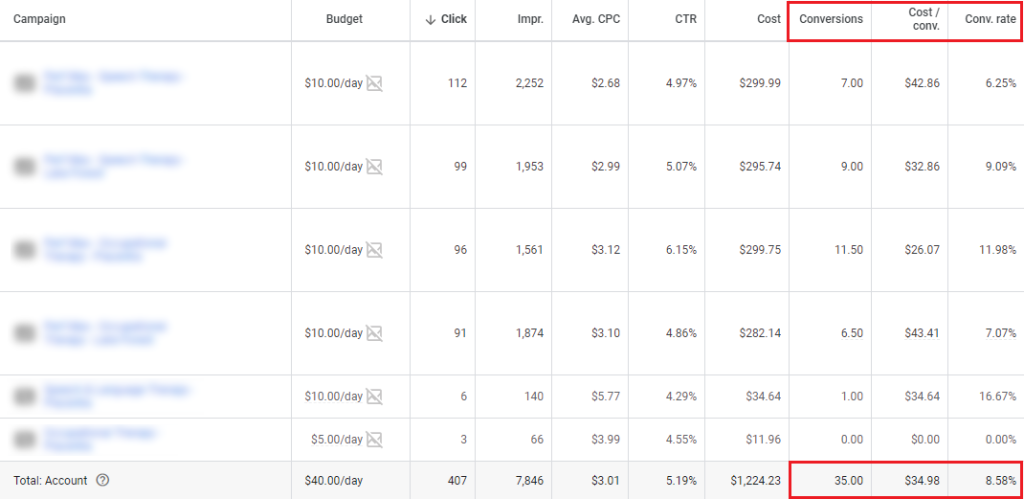
They received 35 leads for a monthly budget of $1200, which comes down to a cost per lead of $35 and a conversion rate of 8.58%.
Also, make sure to track your click-through rate (CTR). It tells you the percentage of people who clicked your ad after seeing it. A high CTR means your ad is relevant and enticing to your target audience.
Your cost per click (CPC) should also be on your radar. Review this to know how much you’re paying each time someone clicks on your ad. Lower CPCs can be a sign of cost-effective ad performance.
To sum it up, you can’t manage what you don’t measure. Regularly tracking these metrics will give you valuable insights, allowing you to tweak your campaigns for better performance and ROI.
Prefer to leave Google Ads to the pros?
Book your consultation and we’ll take it from there.
